Fair competition requires fair contribution
A list of research, tools, and organisations working on fair global tax systems.
A global map of fair tax organisations
Research centres, NGOs, networks, and coalitions all pushing toward a fairer global tax system.
Our Mission
Bringing clarity to global taxation, and visibility to those fighting for it
Global tax debates get lost between technical jargon and political noise.
We bring clarity through research and resources that explain how the system works, where it falls short, and who is working to fix it.
Because you are not alone. There is a growing ecosystem of organisations, advocates, researchers, and events already pushing for a fairer tax system worldwide. You will find them all here.
The work is already happening. We're here to help you find it.
Voices shaping the global tax debate
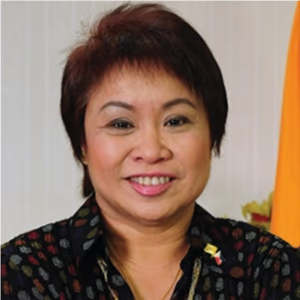
Kim S. Jacinto-Henares
Commissioner at ICRICT
One of Asia's most experienced tax administrators, she served as Commissioner of the Philippines' Bureau of Internal Revenue (2010–2016), where she was known for her fearless pursuit of tax evaders and modernisation of tax collection. She is a Commissioner at ICRICT and a board member of the Tribute Foundation for International Tax Dispute Resolution in The Hague.

Gabriel Zucman
Founding Director of the EU Tax Observatory
Professor at the Paris School of Economics and founding Director of the EU Tax Observatory, his research has reshaped how the world understands tax havens. Creator of the "Zucman tax" — a coordinated 2% minimum tax on centimillionaires, commissioned by the Brazilian G20 presidency in 2024 — he is one of the most influential economists of his generation.
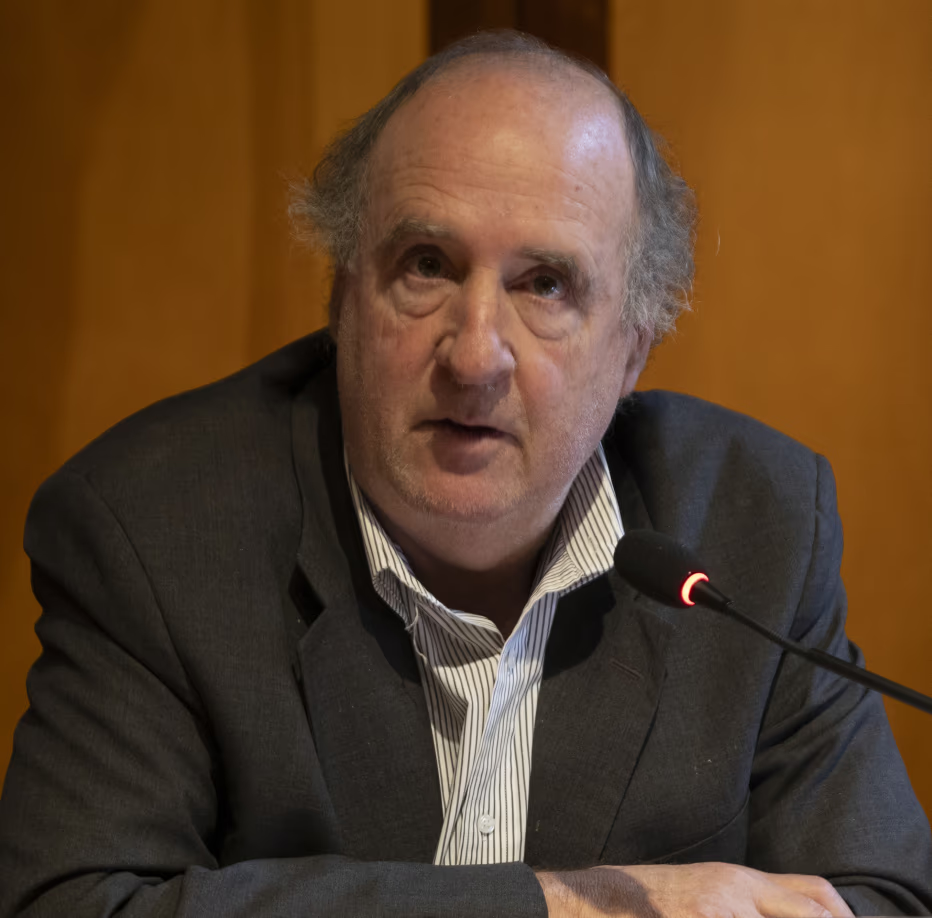
Ricardo Martner
Former Chief of the Fiscal Affairs Unit at CEPAL/ECLAC
An independent Chilean economist and ICRICT commissioner, he brings over 30 years of UN experience to the global tax justice debate. As former Chief of the Fiscal Affairs Unit at CEPAL/ECLAC, he spent 15 years organizing Latin America's most influential fiscal policy forum and driving the implementation of the Addis Ababa Action Agenda across the region. Today he serves as spokesperson for Chile's Tax and Fiscal Justice Network, and is a visiting professor across Latin American universities. A vocal critic of austerity, he has argued that governments should respond to fiscal crises by increasing taxation on multinationals and the super-rich rather than cutting public services and burdening the poorest through consumption taxes.
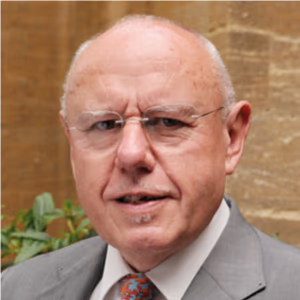
Edmund Valpy Fitzgerald
Professor Emeritus at St Antony's College
Professor Emeritus of International Development Finance at St Antony's College, Oxford, he is one of academia's leading authorities on international taxation and capital flows. A Commissioner at ICRICT, his research on profit shifting and formulary apportionment has informed the work of the UN, the OECD, the UK government, Oxfam, and the Tax Justice Network.
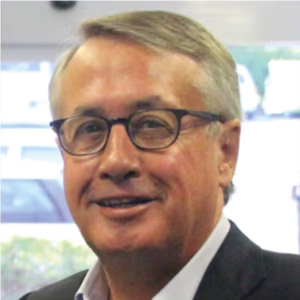
Wayne Swan
Chair of the UN-ESCAP Eminent Expert Group
Australia's longest-serving Labor Treasurer and former Deputy Prime Minister, he steered the country through the 2008 global financial crisis, earning Euromoney's Finance Minister of the Year in 2011. Now a Commissioner at ICRICT and chair of the UN-ESCAP Eminent Expert Group on Tax Policy, he has made building a fairer international tax regime his defining project.

Joseph E. Stiglitz
Co-Chair of ICRICT
Nobel Laureate in Economics and one of the world's most influential public intellectuals, he has made tax justice a cornerstone of his life's work. A Commissioner at ICRICT and co-President of the Initiative for Policy Dialogue at Columbia University, he has argued for decades that rigged tax systems are among the root causes of runaway global inequality.
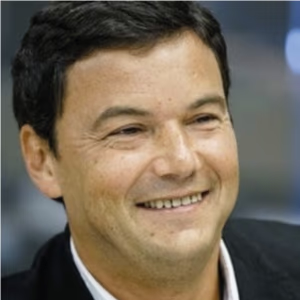
Thomas Piketty
Co-director of the World Inequality Lab and the World Inequality Database
Professor at the Paris School of Economics and co-director of the World Inequality Lab, he is arguably the world's most influential economist on inequality and taxation. His landmark book Capital in the Twenty-First Century reshaped the global debate on wealth concentration, and his proposal for a fully progressive wealth tax — with rates up to 90% — remains among the boldest in the field.
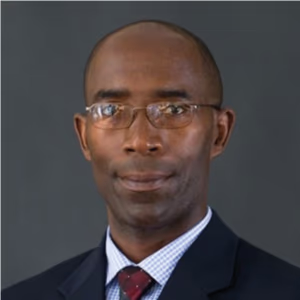
Léonce Ndikumana
Professor of Economics at the University of Massachusetts Amherst
Distinguished Professor of Economics at the University of Massachusetts Amherst and ICRICT Commissioner, he is one of the world's leading experts on capital flight and illicit financial flows from Africa. His research traces how African countries lose billions each year to tax avoidance by multinationals, and he is a consistent advocate for a higher global minimum corporate tax rate that benefits developing nations.

Magdalena Sepúlveda Carmona
Director of the United Nations Research Institute for Social Development (UNRISD)
Chilean human rights lawyer and Director of the UN Research Institute for Social Development (UNRISD), she has spent 22 years bridging poverty, inequality, and policy. A Commissioner at ICRICT and former UN Special Rapporteur on Extreme Poverty and Human Rights, she has consistently argued that an outdated international tax system undermines public services and gender equality.
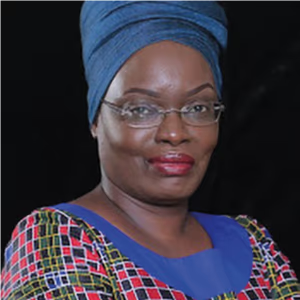
Irene Ovonji-Odida
Chair of the Board of the Tax Justice Network Club de Madrid
Ugandan lawyer, politician, and women's rights activist, she is one of Africa's foremost voices on tax justice and illicit financial flows. A Commissioner at ICRICT and Chair of the Tax Justice Network Club de Madrid, she has championed inclusive global tax rule-setting, including the UN framework convention on international tax cooperation, consistently linking economic governance to gender equality.
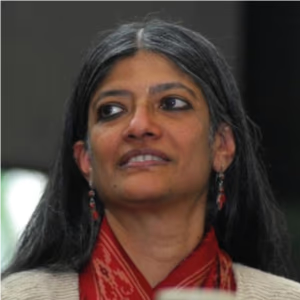
Jayati Ghosh
Co-Chair of the Independent Commission for the Reform of International Corporate Taxation (ICRICT)
Professor of Economics at the University of Massachusetts Amherst and Co-Chair of ICRICT, she is one of the world's leading heterodox development economists. Her work spans globalisation, inequality, gender, and macroeconomic policy, and she has been a vocal critic of G7 governments for exempting US multinationals from the global minimum corporate tax.
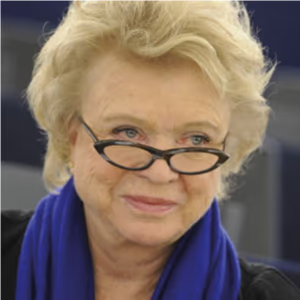
Eva Joly
Former vice-chair of the Commission of Inquiry into Money Laundering, Tax Evasion and Fraud
Norwegian-French lawyer and former European Parliament member, she has built one of the most distinguished careers in the fight against financial crime and tax evasion. As a Paris magistrate, she led the Elf Aquitaine investigation — described as Europe's biggest fraud case since WWII. In the European Parliament, she chaired the inquiry commissions into both LuxLeaks and the Panama Papers.
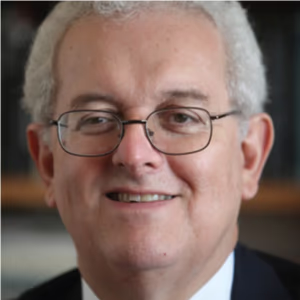
José Antonio Ocampo
Co-Director of the Economic and Political Development Concentration
Colombian economist and Columbia University professor, he has shaped global economic policy at the highest levels — as UN Under-Secretary-General, Executive Secretary of ECLAC, and Colombia's Minister of Finance. A key architect of Colombia's landmark 2022 tax reform, he served as founding Chair of ICRICT from 2015 to 2022 and remains one of the world's leading voices on corporate taxation.
Recent developments, publications, and events in the fiscal justice domain.

119th NTA Annual Conference on Taxation
One of the longest-running research conferences on tax policy and public finance, bringing together economists, lawyers and policy specialists in Pittsburgh.
33rd Session of the UN Tax Committee
The UN's expert body on international tax cooperation meets in Geneva to advance guidance for developing countries on wealth taxation, environmental taxation, and tax and gender.
IMF–World Bank Group Annual Meetings 2026
Finance ministers and central bankers meet in Bangkok to set the global economic agenda, including the policies that shape tax systems in developing countries.
Stay informed
Too much tax news, too little time?
Keeping up with tax justice can feel like a full-time job. That's where we come in. We follow the negotiations, the research and the headlines, then break them down into short, clear posts you can read in a minute.
Fair global tax resources
Reports, publications, and tools used to understand and improve global tax systems.
From transparency standards to policy instruments, these materials reflect years of research, negotiation, and institutional effort.
Explore different methods, evidence, and structures designed to make tax systems clearer, more accountable, and better aligned with the societies they serve.